A-Z : Why Look at Art?
Welcome to my blog. This first series explores why we look at art and the value it brings to our lives—using the alphabet as our guide. Each entry will be short and feature a work of art that illustrates the idea.
Thank you for visiting, and feel free to leave a comment.
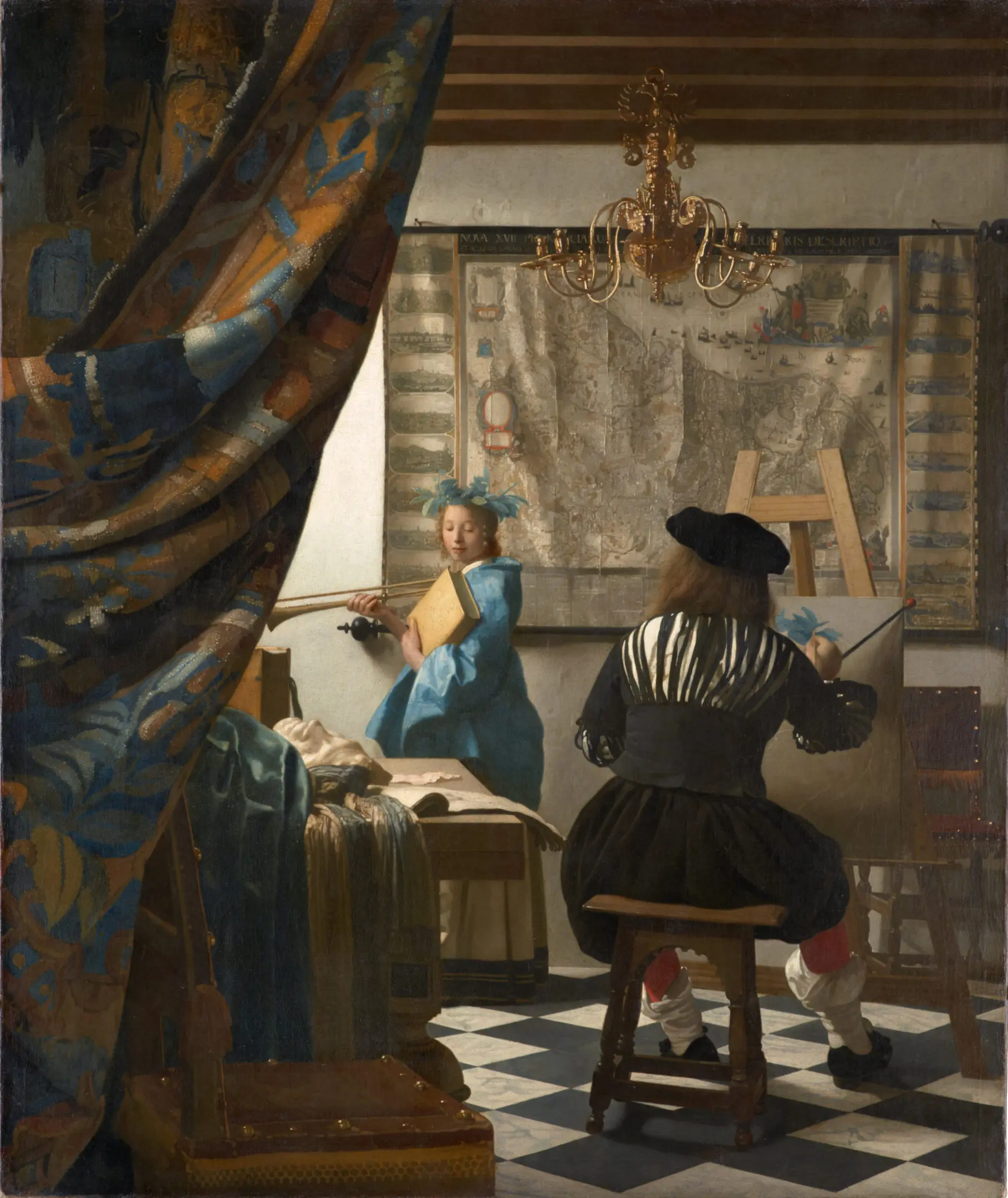
A is for Appreciation: When we look at a work of art, one of the first sensations we often feel is awe at the artist’s ability to transform materials into something expressive and beautiful. Art invites us to step back and simply appreciate the expertise, imagination, and dedication of someone else.
Featured Art: The Art of Painting, 1666-1668. Johannes Vermeer. Dutch. Kunsthistorisches Museum, Vienna.
Prompt for readers: Take a moment to look closely. Describe what you see.
What do you think is going on?
How might this painting reflect the artist’s skill, patience, or imagination?
Art can inspire us to appreciate not only what we see but the hands and minds that made it.

B is for Bold Some art stops us in our path and causes us to ask the obvious question, what is going on?
The boldness of the artist arrests our attention and challenges how we see the world—whether through subject matter, color, or composition. Some create bold images; others shock us through words. Dante Allighieri was among the boldest writer: in his epic poem The Inferno (written around 1314), he dared to condemn political and religious leaders, placing them in Hell for their corruption. It was a radical act that cost him dearly—he was exiled from Florence. Since then, artists have continued to respond to Dante’s vision, crafting bold interpretations that echo his fearless moral clarity and push us to confront uncomfortable truths.
Featured Art High resolution scan of engraving by Gustave Doré illustrating Canto XIX of Divine Comedy, Inferno, by Dante Alighieri. Caption: Dante addresses Pope Nicholas III
https://commons.wikimedia.org/wiki/File:DvinfernoPopeNicholasIII_m.jpg
Prompt for Readers In this wood engraving, we see Dante bent over speaking to Pope Nicholas III whose feet are sticking out of a hole, his feet ablaze by oily fire. Nicholas was sent to the Eighth Circle of Hell for simony, which is the selling of church offices, pardons, or sacred things. The new arrivals push down the ones that are there previously.
https://en.wikipedia.org/wiki/Malebolge#The_Ten_BolgiasTake a moment to look closely.
Describe what you see.
What do you find bold or shocking about this work of art?
What problem would you like to alert others to notice? How would you do it?Art, by the boldness of the artist, can arrest our attention to consider what we might what to avoid.
"Bold art has the power to stop us in our tracks and make us reflect on what we need to think about."

- C is for Critical Thinking
Critical thinking is the ability to examine assumptions and evaluate whether they are true. It involves thoughtful, objective reasoning rather than impulsive or emotionally driven reactions. This is not a skill we are born with—it must be taught and nurtured. We all naturally believe that our personal experience is the correct or only perspective. But if we want to genuinely pursue truth, we must grow in our ability to think critically.
Art can be a powerful way to develop this skill. It challenges us to ask questions, interpret meaning, and consider alternative viewpoints.
- Featured Art:The Treachery of Images(1928–29)
By René Magritte
LACMA, Los Angeles
View artwork and commentary - Prompt for Readers:
Start by asking:What is going on in this picture?
At first glance, it’s clearly a painting of a pipe. But then you read the words beneath it: “This is not a pipe.”
Now is the time for critical thinking.
- What do you think Magritte is trying to say?
- What message or messages might he be communicating?
- List all the possibilities you can think of—there may be more than one!
Next, dig deeper:
- Who was René Magritte?
- Where and when did he live?
- What ideas shaped his work?
- What are some other well-known paintings by him?
- Who were his artistic contemporaries, and what were they exploring?
- Based on what you find, what conclusions can you draw aboutThe Treachery of Images and the ideas behind it?

D is for Discovery
Sometimes when we look at something artists and museums value, we wonder why. Surely there is a story behind the object waiting to be discovered.
Featured Art
Bowl, 9th–10th century, Abbasid caliphate
Tin-glazed earthenware with designs painted in cobalt blue
Iraq, 21.5 cm diameter
© Trustees of the British Museum
https://www.britishmuseum.org/collection/object/W_1923-0725-1
Prompt for Readers
Describe what you see.
What do you think is going on?
Why is this bowl so special? Maybe only a little digging can uncover the significance of this piece.
This bowl was created during the Abbasid Caliphate (750–1258 CE), a time of flourishing intellectual, artistic, and scientific achievement centered in Baghdad. Baghdad was at the heart of the Silk Road and profited from the trade route not only in terms of merchandise but also in the exchange of artistic methods and forms.
Artists in Baghdad tried to imitate the glazes they saw on Chinese pottery, since they did not have the raw materials necessary to make porcelain. They succeeded by inventing a white tin-based glaze as seen on this bowl. In addition, they also developed an iridescent luster glaze. This technique reached from the Middle East to Spain and further into Europe.
What piece of art have you seen that makes you wonder why it is significant?
E is for Elegance
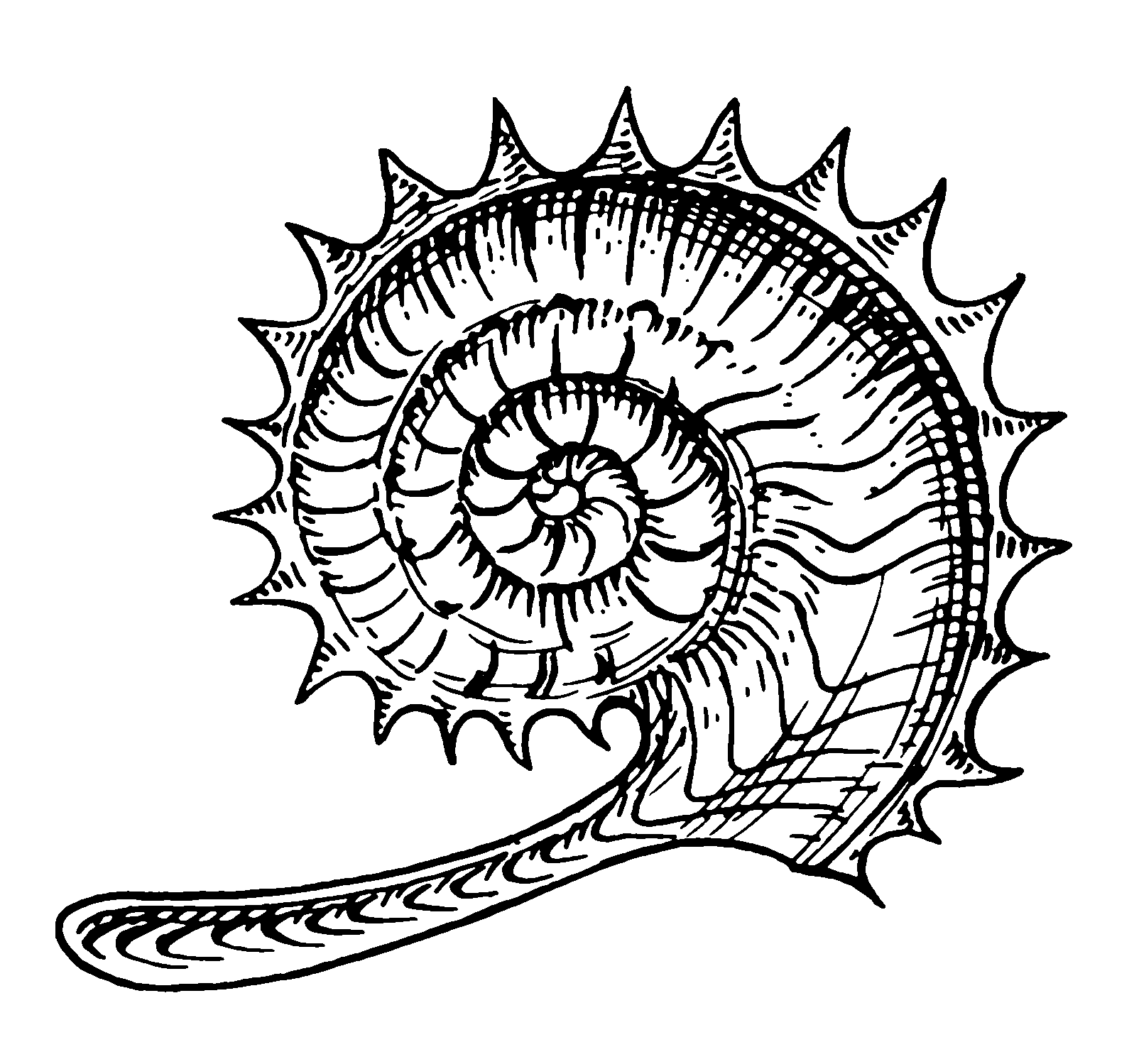
Precision, neatness, and simplicity seem to be the common denominators across disciplines that claim elegance— visual design, fashion, architecture, décor, performance art, science and mathematics. Perhaps all of these take their inspiration from nature.
Featured Art
Line drawing of an ammonite from the Archives of Pearson Scott Foresman, donated to the Wikimedia Foundation.
https://commons.wikimedia.org/wiki/File:Ammonite_(PSF).png
Prompt for Readers
Describe what you see.
What do you think is going on?The structure of an ammonite fossil is considered elegant because it maintains the same proportions as it grows. It is precise, neat, and simple. Patterns such as this abound in nature. Look at the spirals of sunflower seeds on the Head, the Spiral Aloe, the curled tail of a chameleon, the cloud formation of a hurricane, or the sweeping arms of galaxies like the Milky Way. We replicate this pattern consciously and unconsciously whether in the quilt Log Cabin pattern or the Parthenon, or the Guggenheim museum or in Rembrandt’s painting, Self Portrait at the Age of 34. The mathematician Fibonacci plotted this pattern mathematically which now bears his name— the Fibonacci sequence and the older discovery of the Golden Ratio.
Name other things you consider elegant.
Do you aspire to be elegant, live in elegant spaces, or have elegant things? Explain.
.png)